
Every Patient. Every Use.1
FSYX™ Consistently Lowers IOP
Proven Efficacy and Safety Across 600+ Eyes1
100%
of eyes showed lower IOP: 634 eyes studied
97%
of eyes had IOP lowered by >20% at night*
39%
mean IOP reduction, with no serious adverse events
Measurements by Goldmann applanation tonometry show that after cessation of device use, the IOP reverts closely to the IOP measured before device use.
*97% (58/60), as compared to 5% (3/60) of control eyes.
Most Medications Do Not Address Nocturnal IOP Elevation5
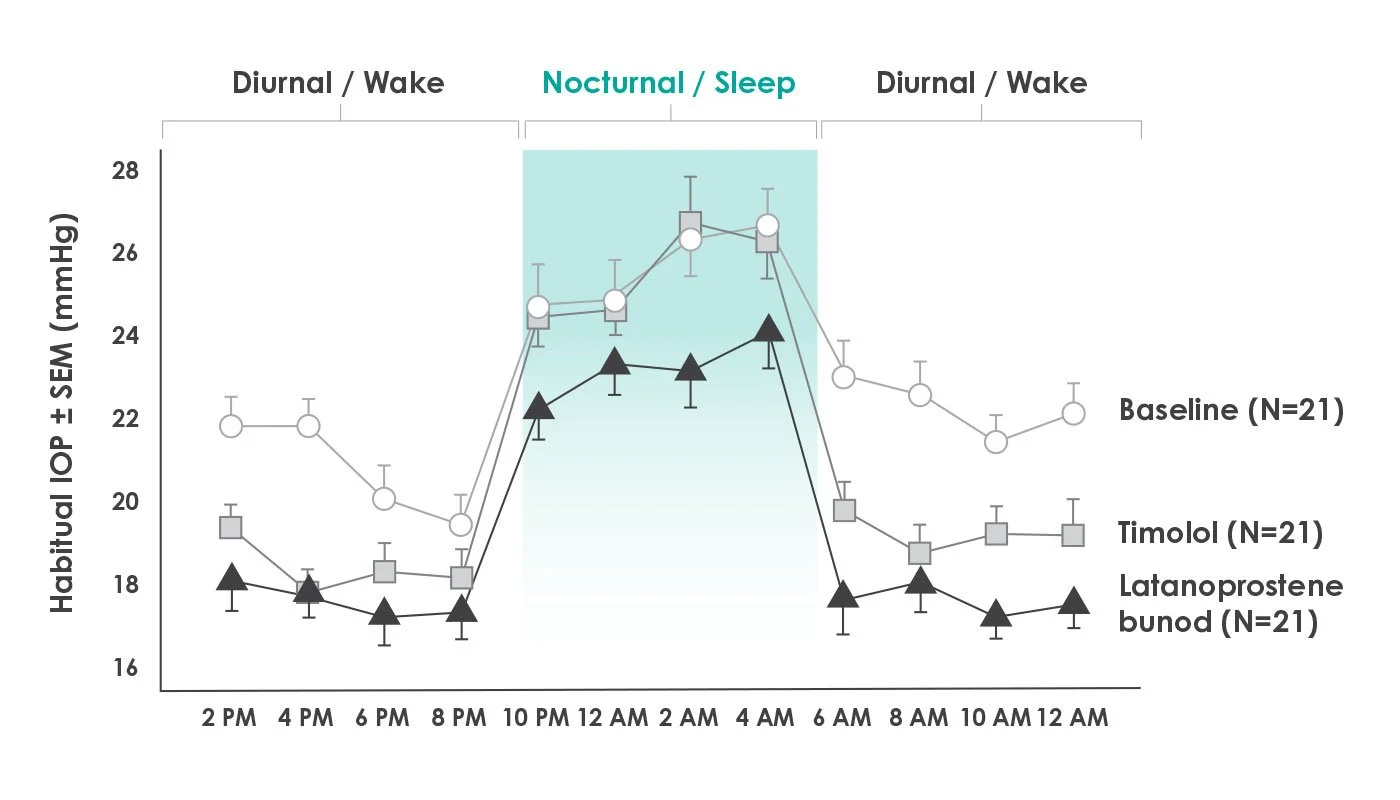
The ability for eye care professionals to manage IOP overnight—when current treatments are less effective—has remained limited. The need to control IOP overnight in patients who don’t demonstrate adequate response to current therapies or whose IOP is already within the normal range has been especially challenging.5
Until now.
Liu JHK, Slight JR, Vittitow JL, Scassellati Sforzolini B, Weinreb RN. Efficacy of Latanoprostene Bunod 0.024% Compared With Timolol 0.5% in Lowering Intraocular Pressure Over 24 Hours. Am J Ophthalmol. 2016;169:249-257. doi:10.1016/j.ajo.2016.04.019
Profiles of 24-hour habitual intraocular pressure (IOP). Measurements were obtained from 21 subjects sitting during the diurnal/wake period and supine during the nocturnal/sleep period. Open circles represent the baseline, solid triangles represent post-4-week treatment with latanoprostene bunod 0.024% once daily, and solid squares represent post-4-week treatment with timolol 0.5% solution twice daily. Error bars represent standard error of the mean.
FSYX™ Studied for Effectiveness in HERCULES Trial
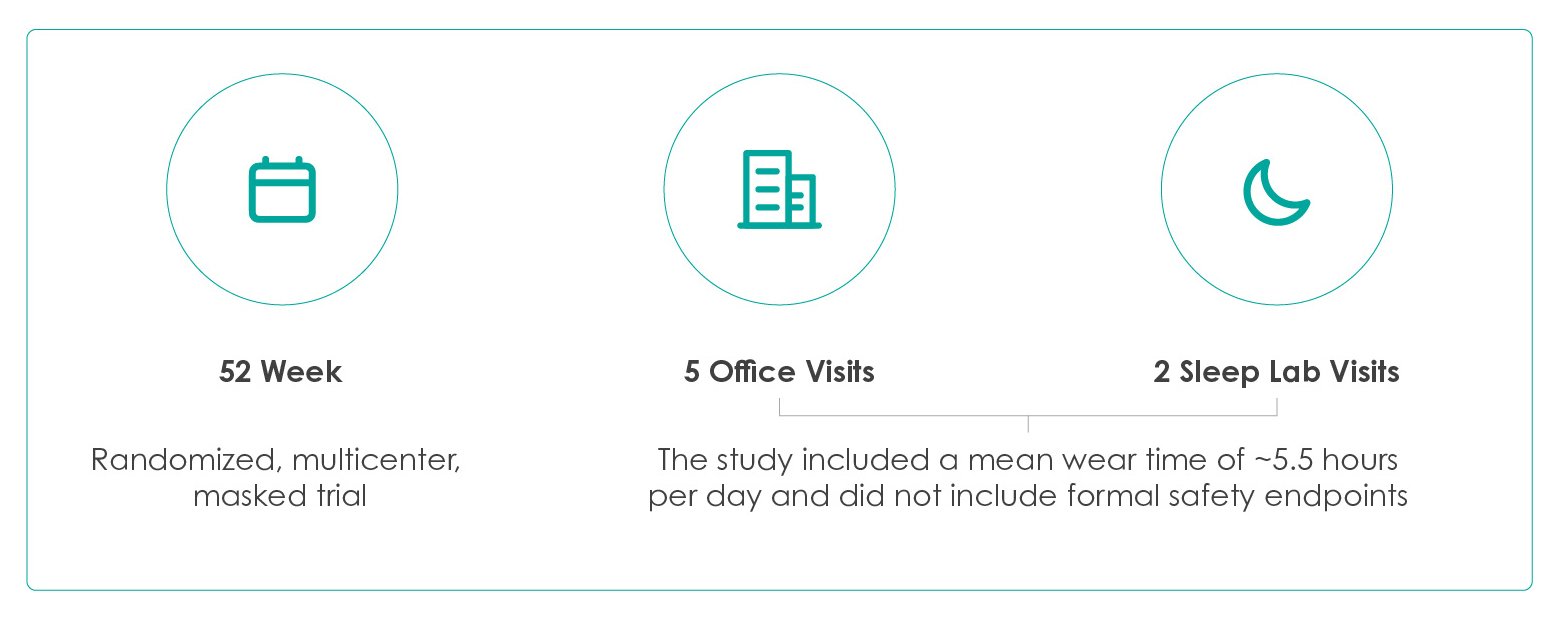
See HERCULES Trial study for a complete listing of key inclusion and exclusion criteria.
Following 5 years of interactions with the Food and Drug Administration (FDA) on FSYX™ OPAP, Balance Ophthalmics submitted a request for de novo classification (providing regulatory guidance for a novel medical device) in August 2023. This submission included 12-month data, a narrowed indication, and the HERCULES study, per request for additional information by the FDA. The Ophthalmic Devices Panel of the FDA's Medical Devices Advisory Committee voted unanimously (13-0) that FSYX™ Ocular Pressure Adjusting Pump® (OPAP) is effective and safe for treating glaucoma in the current indication. Following this resounding endorsement, the FDA awarded de novo classification.
FSYX™ Safety Findings1
Safety assessments of FSYX™ OPAP do not reflect any worsening in clinical outcomes or unanticipated adverse device effects, and there were no clinically significant elevations in mean IOP after removing FSYX™ OPAP.
Although treatment may induce temporary lid edema (puffiness), it does not lead to persistent or harmful outcomes.
FSYX™ demonstrated:
No device-related serious adverse events
No adverse events reflective of damage to structure and function of optic nerve or anterior segment
No hypotony
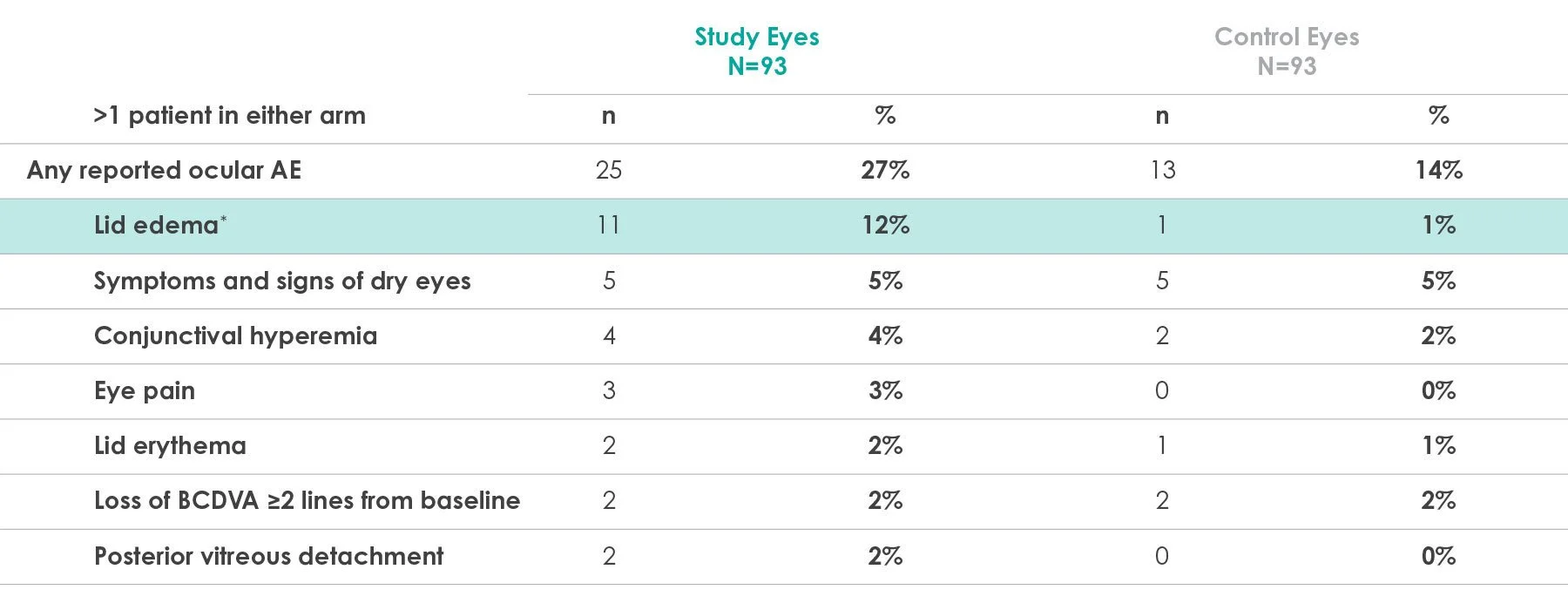
*One study eye was reported with a severe adverse event of eyelid edema.
The safety and effectiveness of the FSYX™ OPAP has not been established in patients with penetrating keratoplasty or prior sub-conjunctival glaucoma surgery, such as trabeculectomy and tube shunt. There is insufficient safety and effectiveness data for treatment durations >6 hours and for negative pressure (NP) settings ≥-17 mm Hg. Treatment durations between 6 and 8 hours and/or treatment at NP levels ≥-17 mm Hg should be undertaken with caution. Treatment duration greater than 8 hours/session is not recommended.
Patients using the FSYX™ OPAP should not modify or discontinue any of their other glaucoma treatments without consultation with their healthcare provider.
Additional Publications
- Evaluation of the IOP-Lowering Effect of a Multi-Pressure Dial at Different Negative Pressure Settings
- Intraocular Pressure Measurement with Pneumatonometry and a Tonometer Tip Cover
- Open-Angle Glaucoma: Burden of Illness, Current Therapies, and the Management of Nocturnal IOP Variation
- Short-term Evaluation of Negative Pressure Applied by the Multi-Pressure Dial System to Lower Nocturnal IOP: A Prospective, Controlled, Intra-Subject Study
- The Effects of Negative Periocular Pressure on Intraocular Pressure
- Evaluation of Negative Pressure Transfer Through Tissue in a Benchtop Cornea and Eyelid Model
- Multipressure Dial Goggle Effects on Circumpapillary Structure and Microvasculature in Glaucoma Patients
- Overnight Safety Evaluation of a Multi-Pressure Dial in Eyes with Glaucoma: Prospective, Open-Label, Randomized Study
- The Effect of Periocular Negative Pressure Application on Intraocular and Retrobulbar Pressure in Human Cadaver Eyes
- Short-Term Safety Evaluation of a Multi-Pressure Dial: A Prospective, Open-Label, Non-Randomized Study
- Periodic Normalization of the Translaminar Pressure Gradient Prevents Glaucomatous Damage
- Short-Term Steady-State Pattern Electroretinography Changes Using a Multi-Pressure Dial in Ocular Hypertensive, Glaucoma Suspect, and Mild Open-Angle Glaucoma Patients: A Randomized, Controlled, Prospective, Pilot Study
- The Effects of Negative Periocular Pressure on Biomechanics of the Optic Nerve Head and Cornea: A Computational Modeling Study
- 8 hrs Safety Evaluation of a Multi-Pressure Dial in Eyes With Glaucoma: Prospective, Open-Label, Randomized Study